

Q2 2026 Dispatch
Welcome to the fourth quarterly dispatch.
This edition follows a slightly adjusted format. Q2 at a Glance offers a TL;DR of the quarter for readers who want the main points, while the sections that follow examine the decisions, tradeoffs, and work behind them in more detail.
Q2 at a Glance
-
Company: No major operational changes this quarter. Work remained centered on completing the playable prototype.
-
Websites: No major public-facing site changes.
-
Community: Broader outreach remains on hold until the playable can communicate the intended experience without extensive explanation.
Production
Q2 began by completing the cohesion and stabilization work carried forward from the start of the year. That process exposed one remaining assumption that affected nearly every part of the prototype: its monthly progression. After further testing, the simulation was fully transitioned to a seasonal cadence, and the project’s systems, older logic, documentation, rendering, and shaders were brought into alignment with that decision.
The environmental side of the prototype was also revised so that the passage of time is more visible. Seasonal lighting and atmospheric changes were added, the terrain was improved, and rivers became part of map generation. Irrigation was then moved out of the farm itself and connected to player-built water channels, requiring farms to receive water from rivers before irrigation benefits can be enabled.
Alongside this work, an early narrative harness was tested and showed enough promise to establish a direction for the playable. Peripheral features and broader experiments have now been frozen so development can focus on connecting that narrative experience to the simulation and assembling a coherent build for external testing in Q3.
From Months to Seasons
The monthly cadence was originally introduced as a structured alternative to developing the prototype around real-time progression. It made the simulation easier to inspect and allowed individual systems to resolve in predictable steps.
As more of those systems came together, however, the limits of that cadence became increasingly apparent. Too little could meaningfully change between many monthly transitions. The city would advance and its systems would resolve, but the passage of time did not always carry enough weight. It also created a rhythm that felt too granular for the kind of experience I am trying to build.
The Vizier is intended to model social, economic, and political change, not simply process construction and production orders. Those changes require time before they can become legible. Seasonal progression provides a more useful interval: it remains structured, but more importantly, it gives the player enough space to assess the city, make decisions, and observe their consequences without the simulation feeling either empty or unnecessarily pressured.
Because time affects nearly every system, this was not an isolated change. Construction, food consumption, production, stability, population conditions, and other parts of the simulation all had to be reviewed and updated around seasonal resolution. As a result, the prototype now advances through one consistent model of time, with seasonal progression forming the basis for both the current simulation and the narrative work being built around it.
A More Responsive Landscape
Once the simulation began advancing seasonally, the world needed to communicate that change more clearly.
Previously, values and notifications could indicate that a new period had begun, but the environment itself remained static. A focused visual pass was therefore completed across seasonal lighting, cloud cover, atmospheric conditions, terrain textures, and the distribution of grass, soil, and vegetation.
The goal was not to establish the game’s final art direction as the current visuals remain temporary. Instead, the work was intended to make the prototype’s state easier to read and ensure that advancing between seasons feels like a meaningful passage of time rather than an invisible calculation.
The underlying work required for that pass also created the foundation needed to introduce rivers and player-built water channels. Both had already been planned, but earlier technical and environmental limitations had kept them lower on the development list.
That mattered because water management and irrigation were central to agriculture and settlement development during the historical period represented by the game. Rather than treating irrigation as an abstract upgrade contained inside a farm, the system could now be connected to the landscape itself.
Irrigation previously existed as an internal farm option. The player could enable it, pay its upkeep, and gain access to improved yields and additional crops. While functional, that approach separated irrigation from the source of the water and the infrastructure required to move it.
That relationship is now external. Rivers form part of the generated landscape and provide the natural water source for channels constructed by the player. Those channels must connect a river to agricultural land before irrigation can be enabled. Farms can still benefit from increased yields and additional crop options, but those benefits now depend on infrastructure the player has physically placed in the world.
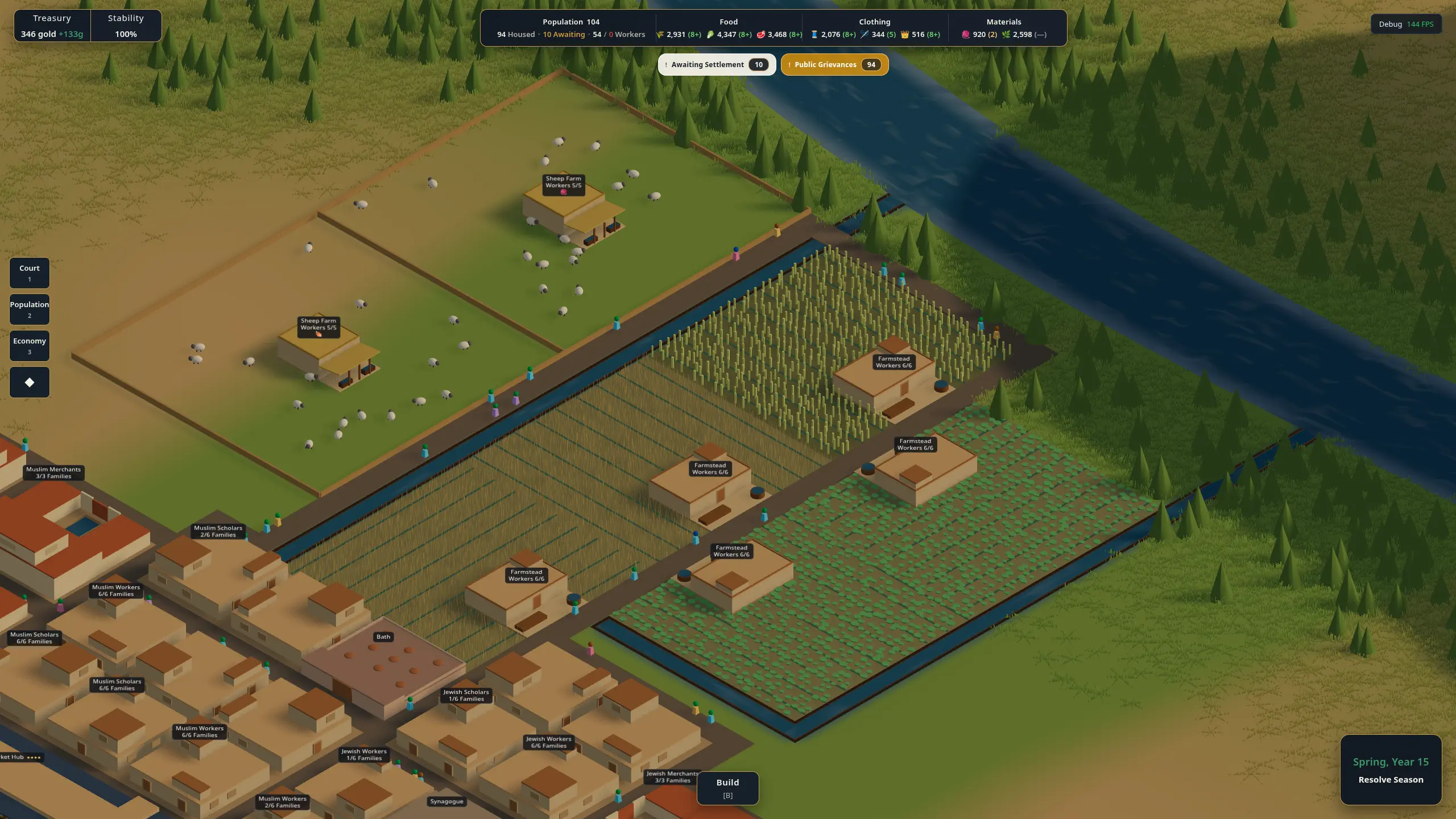
Implementing this required the existing farming and irrigation logic to be revised around external water connections, while the terrain was updated to respond visually as channels are placed. The broader environmental work also included rendering and shader improvements that produced measurable performance gains.
The current implementation remains limited, but it replaces a weaker abstraction with a more grounded relationship between water, land, and agriculture. It also establishes a foundation that can support more developed forms of water management during full production.
Narrative Takes Shape
Work on the narrative side started taking shape in Q2, and several iterations were tested for how narrative situations, dialogue, and decisions could be presented within the existing prototype. I developed one of those iterations into a small working validation harness and it showed enough promise to establish the current direction.
The harness primarily validated presentation, dialogue flow, interface placement, and the broader experience of interacting with narrative material inside the city-management layer. Even in that early form, it added context to the existing systems and made the player’s role as a vizier feel more tangible, and the city was no longer only a collection of values, buildings, and production chains.
I am not ready to show its interface publicly because it remains under active development and has not yet been fully tested as part of the complete playable experience. The important change this quarter, however, is that the narrative direction is no longer entirely theoretical. An early working version has validated the basic interaction approach, and the current effort is focused on turning that result into the limited but complete implementation required by the playable prototype.
Measuring the Work
As in previous dispatches, the chart below uses code churn to make otherwise invisible development activity more legible. It measures how much the project changed during the quarter, not the quality of those changes or the size of the finished game.
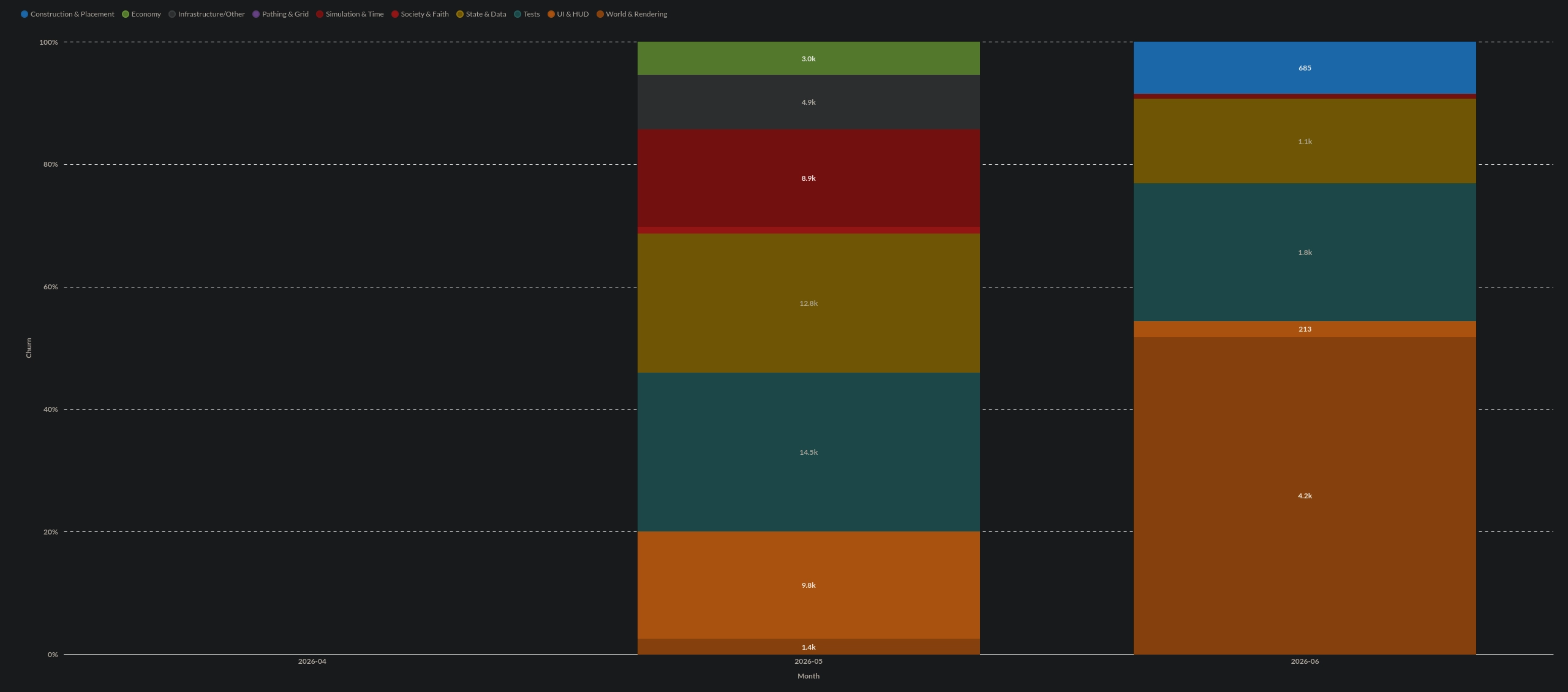
Main-branch churn was concentrated in May, when the seasonal migration and related cleanup produced broad changes across the simulation, state and data, tests, interface, and rendering. June was smaller and more focused, reflecting the later environmental and integration work.
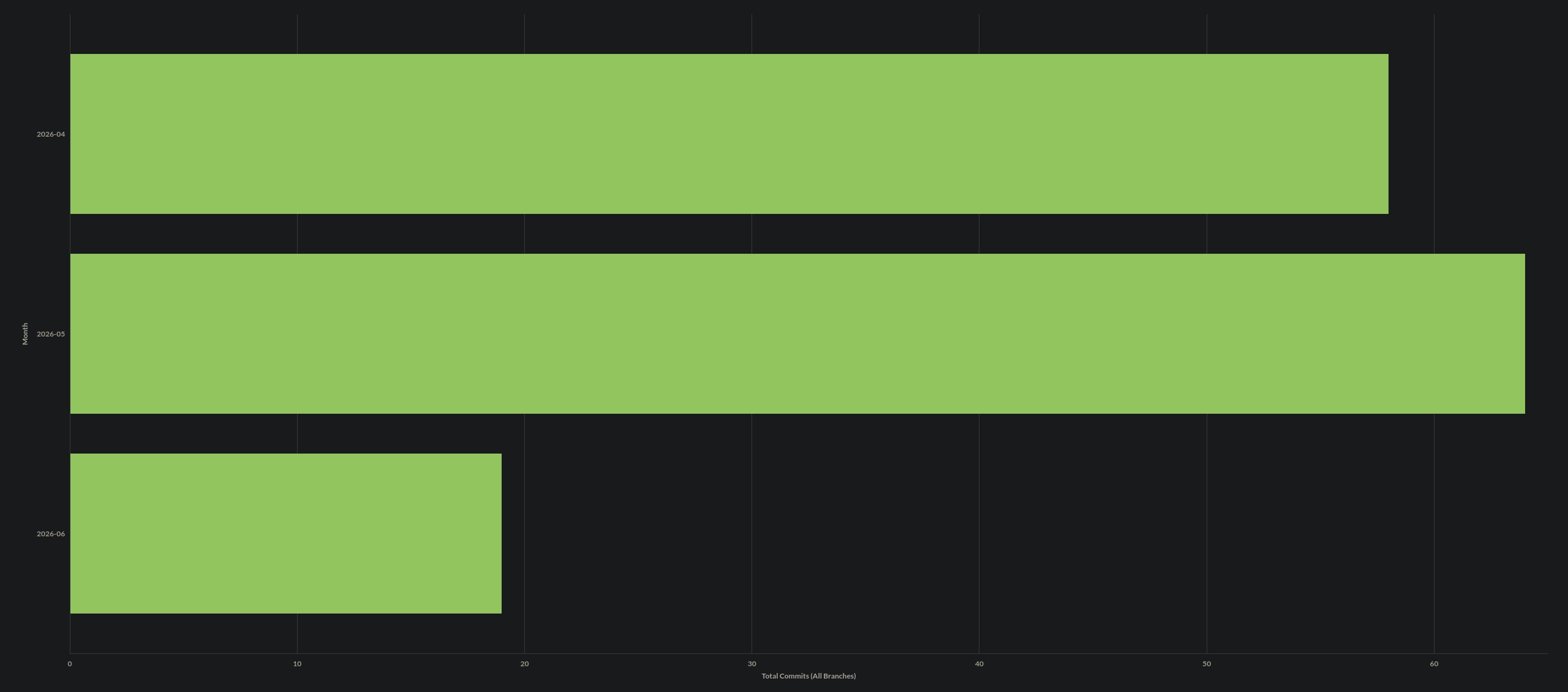
April shows no main-branch churn because its work remained on feature branches rather than being merged. The all-branch history records 58 commits in April, followed by 64 in May and 19 in June. These figures exclude the ongoing narrative work, which had not yet been merged into the main branch.
Looking Ahead
The project remains independently funded and developed without the sustained capacity of a financed production team. This constrains both the time available and the number of areas that I can pursue simultaneously. Narrowing the prototype is therefore not only a design choice but a production necessity.
The immediate priority in Q3 is to complete the narrative implementation and assemble the playable experience surrounding it. That work extends beyond narrative alone. The interface still requires further refinement, the build needs a focused audio pass, and the process through which external testers will access and evaluate it must be prepared.
Open-ended feature development has stopped in order to reach that point. Several branches and broader ideas have been frozen, including work that may still belong in the commercial game but is not required to validate the current prototype.
The work ahead is to give the systems that already exist context, consequence, and a defined playable structure: where the experience begins, what the player encounters, and what constitutes a meaningful endpoint.
External testing will begin during Q3 once that experience has been assembled. Its outcome will determine the steps that follow. The build may validate the current direction while identifying areas for refinement, or it may expose larger assumptions that require more substantial changes. Discovering which of those outcomes is true is the purpose of testing the experience as a whole rather than continuing to assess its systems in private.
The objective is not to present the prototype as a finished expression of the full game. It is to create a playable foundation that can demonstrate what works, reveal what does not, and provide the evidence needed to guide future development, funding conversations, and the production team required to build the full project.
Thank you for following along and for reading the fourth quarterly dispatch.
Sincerely,
Mohammad
Links: Founder LinkedIn | Mizan Interactive LinkedIn | The Vizier | Community Discord